
 (1).webp)
* All product/brand names, logos, and trademarks are property of their respective owners.
When people plan a renovation, most of the excitement goes toward the big decisions: flooring, paint colour, the sofa that will anchor the room. These are the choices that end up in "before and after" photos, so, understandably, they get the most attention.
What rarely comes up are the smaller, less glamorous products that quietly decide whether a renovation looks finished — and whether it stays that way. Tile trim, skirting boards, underlay, and a few other easily overlooked items often get bought in a last-minute rush once the "real" work is done. Yet these are often the products that protect your investment, smooth over awkward junctions, and stop minor issues from turning into costly ones.
This article walks through a Home renovation from start to finish, highlighting essentials that are easy to forget but worth planning.
Before a single tile goes down or a wall gets painted, it's worth thinking about what's already in the room and how to keep it intact. Renovation work — sanding, tiling, painting, laying new flooring — kicks up dust, splashes and debris that travel further than most people expect.
This is where dust sheets prove their worth: a simple, underrated item that shields existing flooring, furniture and fittings from paint drips, plaster dust and general mess, cutting down on cleanup and the risk of damaging surfaces you weren't even working on.
Not every dust sheet does the same job:
Once the room is protected and old flooring pulled up, attention usually jumps straight to the new floor covering. But what sits beneath it matters just as much — arguably more.
Flooring underlay sits between the subfloor and the finished surface, and does more work than most people realise. It:
Skip this step, or use the wrong type, and the floor can feel harder underfoot or start creaking sooner than expected. Thickness, density, and moisture resistance all vary by flooring type, so checking the manufacturer's recommendations before buying underlay saves compatibility headaches later.
Standard underlay focuses mainly on comfort and floor protection, but there's a separate category worth knowing about: acoustic underlay.
Acoustic underlay is built with sound transmission in mind, especially impact noise — footsteps, dropped objects, furniture being dragged across a room. This matters most for flats with neighbours below, and many leasehold agreements or building regulations require a minimum level of impact sound insulation for hard flooring. But bedrooms above living rooms, home offices, and busy households with kids or pets can also benefit from some extra sound dampening underfoot.
The key thing to remember: standard underlay is mainly about comfort, insulation, and floor protection, while acoustic underlay is specifically engineered to reduce impact noise between floors. If noise is a real concern, check a product's impact sound reduction rating rather than assuming any underlay will do.
Once flooring is down and tiling gets underway, edges and transitions become the next detail worth thinking through, and this is where tile trim quietly earns its keep.
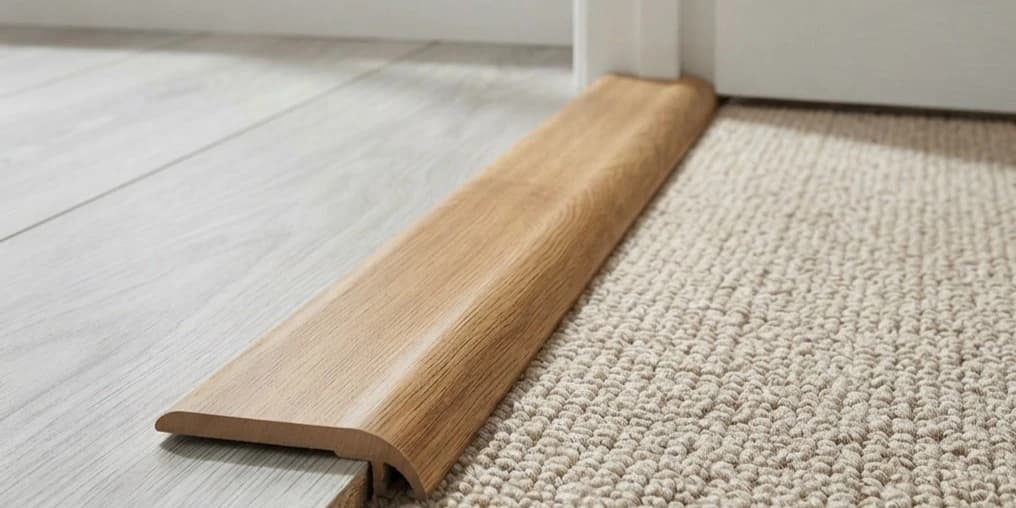
Tile trim serves both a practical and visual purpose. Practically, it protects exposed tile edges from chipping, covers the raw edge so moisture can't creep in behind it, and creates clean floor transition strips between tile and whatever's next to it. Visually, it turns a rough, unfinished edge into a neat, intentional line.
Choosing the right trim comes down to a few factors:
It's a small product, but a mismatched or poorly fitted trim is exactly the kind of detail that catches the eye in an otherwise well-tiled room.
Skirting boards are another detail easy to treat as a formality, yet they do real structural and practical work alongside their visual role.
Choosing a profile that matches the property's character, rather than whatever's cheapest, makes a noticeable difference to how finished a room feels.
With flooring, edges and skirting sorted, it's tempting to think the renovation is done. But if rugs are part of the plan, there's one more detail worth considering: a rug gripper.
Rugs behave differently depending on what they sit on. On carpet, a rug can bunch up or slowly migrate across the room. On hard flooring like laminate, vinyl, or tile, a rug without grip can slide underfoot — a genuine trip hazard, particularly in hallways and homes with young children or older residents.
A rug gripper works by creating friction between the rug and the floor, keeping it in place without adhesive or fixings that could damage either surface. Rug Grippers made for hard floors typically use a different material and grip pattern than those designed for carpet, and some products work across both — worth checking compatibility before buying.
It's a modest addition, but one that protects both the rug and the floor beneath it, and makes the finished room genuinely safer to walk through.
A renovation is judged, in the end, by how it looks and how it holds up over time — and both outcomes are shaped as much by the details underneath and around the visible surfaces as by the surfaces themselves. Dust sheets protect the work in progress. Underlay, including acoustic underlay where needed, supports the floor above it. Tile trim and skirting boards finish edges that would otherwise look unresolved. A rug gripper keeps the final layer safely in place.
None of these products are the star of the finished room, and that's the point. Good results often come down to the materials people don't notice — the ones quietly doing their job long after the paint has dried. Planning for them from the outset, rather than treating them as an afterthought, is one of the simplest ways to make a renovation genuinely last.
For those sourcing these kinds of finishing details, a range of DIY and renovation products — including underlay, trims, and protective products — can be found through Mafson, alongside the usual builders' merchants and DIY retailers.

There's a particular kind of room that looks "finished" without you being able to say exactly why. O
7 September 2026
Every trade counter and builders' merchant has a section that's slightly harder to categorise than t
3 September 2026
Managing the complete clearing of a residential estate requires a meticulous approach to logistics,
5 June 2026
Be the first to share your thoughts
No comments yet. Be the first to comment!
Share your thoughts and join the discussion below.



.webp&w=3840&q=75)
.webp&w=3840&q=75)


.webp&w=3840&q=75)

.webp&w=3840&q=75)
.webp&w=3840&q=75)