* All product/brand names, logos, and trademarks are property of their respective owners.
More and more companies across the US are implementing commercial solar projects as electricity costs are rising, and companies that utilize such energy solutions become more energy independent. Solar power can be effectively used in many commercial projects, among which office buildings, factories, warehouses, hospitals, hotels, schools, and shopping centers can be mentioned. A variety of technical and financial schemes can be used for different commercial applications. Commercial solar projects demand that developers to possess specific expertise since, unlike residential solar systems, they require comprehensive study of power consumption, called "sanctioned load", availability of capabilities of the roof space, tariffs imposed on energy consumption, operating hours of the establishment, grid regulation, and financial objectives of the investor. This means that selecting the right solar system requires more than just putting solar panels on the roof.
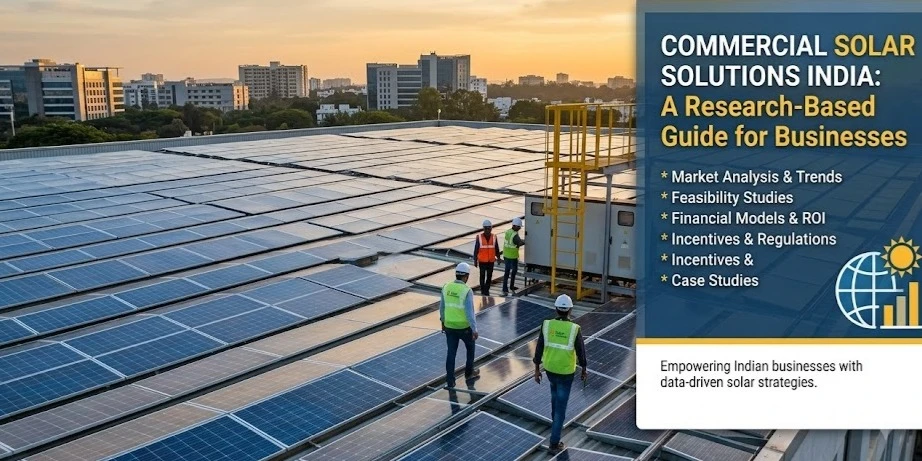
Many companies across India have a powerful daytime demand for electricity. This is where solar generation comes in very handy because solar technology functions in the very same time period when the majority of businesses operate. Commercial solar solutions in India enable enterprises to lessen their reliance on electricity from the grid, as well as the risk of changing electricity tariffs. Solar generation will help achieve corporate sustainability goals since electricity is produced without reliance on conventional sources. The Ministry of New and Renewable Energy continues to promote the deployment of grid-tied rooftop solar systems in the country. At the same time, businesses must understand the difference between programmes that provide subsidies for home systems and those for commercial enterprises so that they know what exact regulations, incentives, and electricity settlement mechanisms apply.
Factors that determine the financial value of a solar project include, among others, the electricity tariff, electricity need, solar production, capital cost of the project, financing expenses, maintenance costs, and any relevant regulatory fees. Rooftop solar is a good source of savings for a business that uses electricity during daylight hours, as such a business will be able to use a larger amount of electricity generated from solar panels on-site and thus decrease the amount of electricity purchased from the grid. However, businesses should not evaluate the project just by the initial installation costs. The financial analysis should cover expected annual generation of the system, degradation, maintenance, warranties on equipment, escalation of tariffs, financing, and expected life of the system.
Various commercial premises require varying solar setups based on their electricity usage, operational hours, geographical location and whether they are in need of backup power systems. Connected as part of the utility grid, on grid rooftop solar solutions are appropriate for factories, offices, hospitals, warehouses or commercial establishments with a significant electricity requirement for daytime hours making them capable of reducing dependence on the power utility. Hybrid solar power systems that use solar panels, batteries, and utility grid connectivity allow businesses to enjoy high levels of flexibility in terms of energy supply and standby electricity during power outages. Off-grid solar systems plus storing solar power storage devices on the other hand, are designed to work independently from the grid and are particularly useful in areas where there is a poor electricity supply. It is clear from the above that businesses need to analyze their consumption profile, the amount of solar roof space they have, the reliability of the electricity supplied from the grid, and their backup requirements before choosing the most suitable system.
Before starting any solar project, commercial organizations should conduct an elaborate study ahead of buying their equipment. This means that a business should analyze their electricity expenditures, consumption history, peak demand, hours of operation, variations over seasons, and intervals in order to recognize its load profile. Failure to do so may have negative consequences, as two companies that use the same amount of energy each year can have different solar plants due to the timing of electricity consumption. For example, a warehouse that mainly works during the daytime can consume most of the energy generated by its solar panels, while a business that consumes a lot of energy at night may benefit more from battery storage or other renewable energy sources. In addition to understanding the electricity consumption, it is necessary to assess the roof and electrical parts of the building. The engineers will have to check the following roofing attributes: strength, shading, orientation, available installation area, drainage, accessibility, transformer capacity, official electrical load, cable runs, security systems, inverter configuration, and grid connection specifications.
Various finance options can be utilized by businesses for the execution of commercial solar projects, depending on the degree of their capital, energy consumption, and long-term objectives. Under the CAPEX model, a business buys a solar system and becomes its owner; it incurs all expenditures that occur at this stage and keeps all the eventual savings and benefits. Both RESCO and PPA models have the feature of the involvement of a third party in financing, installing, owning, and maintaining the renewable energy system. Under these models, the consumer is only required to pay the fixed price for the electricity received. Moreover, the conditions of the contract should also be discussed, including its terms, price increases, guarantees, and maintenance services.
Big customers can utilize open access procurement as long as allowed by law; however, they should be aware of the potential negative influence of tariffs and other state costs on project profitability. In addition to financing, the company must take into consideration compliance with all government regulations governing the choice of equipment with respect to efficiency, reliability, warranty, availability of after-sales service, working conditions, and relevance of the equipment. Realization includes energy study, site inspection, designing the system, estimating energy production, structural examination, financial appraisal, authorization, purchase, installation, connection to the grid, and system commissioning and testing.
The commercial solar industry will continue to follow trends in electricity regulation and the purchase of renewable energy as well as storage and corporate sustainability standards. Recent announcements from the MNRE indicate that there is ongoing regulation regarding solar batteries, cells, open access, and net-metering. Therefore, companies have to analyze both their current operating environment and their electricity needs for the future. If properly planned, the installation of a solar energy system will be considered a long-term source of energy instead of being regarded solely as a cost item.
Commercial solar solutions in India allow companies to leverage several options meant to minimize the reliance on traditional sources of power and increase utilization of sustainable energy. The list of possible applications includes rooftop solar equipment, hybrid setups, storage technologies, and CAPEX projects, as well as RESCO and open access. The most effective method is to start with determining the electricity consumption and operational necessities before deciding on the capacity of the system. The organizations need to deal with load estimation, roof capabilities, grid terms of operations, analysis of profitability, equipment suitability, and maintenance obligations.

Managing a medical practice involves much more than treating patients. Healthcare professionals must
2 October 2026
Servers are at the heart of many modern businesses. They store important data, run applications, hos
24 September 2026
Businesses rely on servers for many of their most important daily operations. Websites, databases, b
23 September 2026
Be the first to share your thoughts
No comments yet. Be the first to comment!
Share your thoughts and join the discussion below.