* All product/brand names, logos, and trademarks are property of their respective owners.
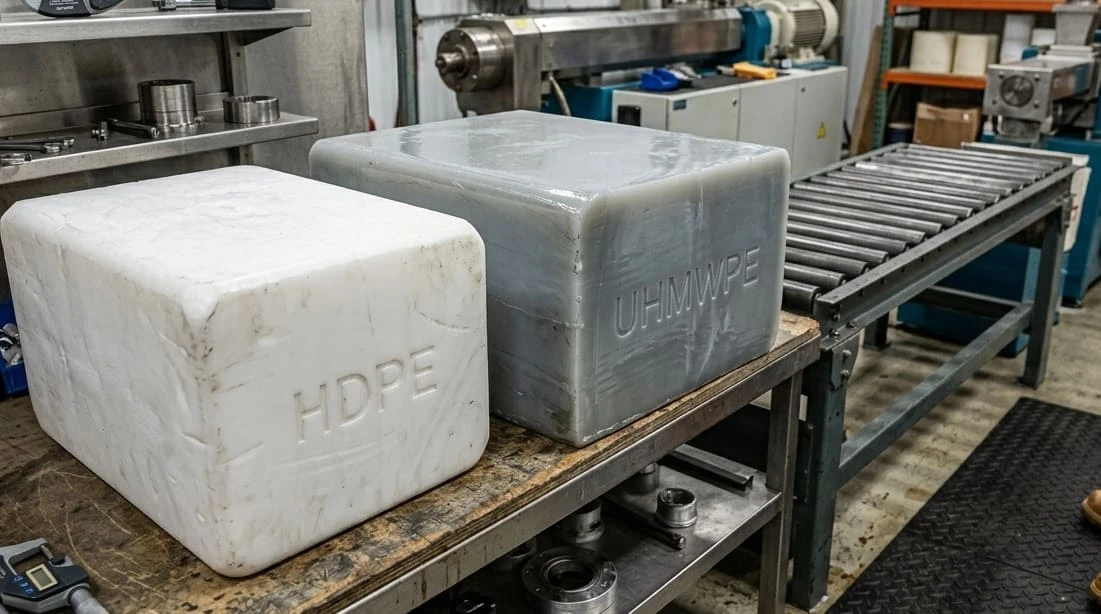
Choosing between HDPE and UHMWPE can make a big difference to how well a part performs, especially in demanding industrial settings. Both materials are tough, lightweight, moisture-resistant plastics, but they are not designed for the same jobs. HDPE is often chosen for general-purpose applications where durability, chemical resistance, and value matter. UHMWPE is usually selected when the application involves heavy wear, repeated impact, or low-friction movement. Understanding the difference helps buyers avoid overspending on the wrong material or under-specifying a part that may wear out too quickly.
HDPE (High-Density Polyethylene) is a widely used thermoplastic known for its excellent chemical resistance, low moisture absorption, and reliable durability. It is commonly found in storage tanks, pipe systems, fabrication projects, food processing equipment, and protective liners. Thanks to its balance of performance and affordability, HDPE remains a popular choice for many industrial and commercial applications.
UHMWPE (Ultra High Molecular Weight Polyethylene) belongs to the same polyethylene family but features much longer molecular chains. This enhanced molecular structure provides exceptional abrasion resistance, outstanding impact strength, and a naturally low coefficient of friction. As a result, UHMWPE is frequently used for conveyor components, guide rails, wear strips, chute liners, and other high-wear applications.
When comparing HDPE vs UHMWPE, the biggest distinction lies in performance under demanding conditions. Standard HDPE Sheets offer a cost-effective solution for general-purpose industrial use, while UHMWPE Sheets are designed for environments where wear resistance, impact absorption, and reduced friction are critical. Understanding these fundamental characteristics makes it easier to determine which material is better suited to a specific application before evaluating its performance in greater detail.
The biggest difference in the HDPE vs UHMWPE comparison is durability under demanding conditions. UHMWPE offers superior abrasion resistance and can withstand repeated impacts, making it ideal for high-wear applications. HDPE is also tough and durable, but is generally better suited to moderate-duty environments.
UHMWPE has a much lower coefficient of friction than HDPE, allowing materials to slide more easily across its surface. This makes it a preferred choice for conveyor systems, guide rails, and material handling equipment where smooth movement is important.
HDPE is typically the more affordable option and provides excellent chemical resistance, moisture resistance, and overall performance for a wide range of applications. UHMWPE comes at a higher cost but delivers additional benefits where wear resistance and impact strength are critical.
| Property | HDPE | UHMWPE |
|---|---|---|
| Wear Resistance | Good | Excellent |
| Impact Strength | High | Very High |
| Friction Level | Low | Extremely Low |
| Chemical Resistance | Excellent | Excellent |
| Cost | Lower | Higher |
| Best For | General industrial use | High-wear environments |
For many projects, HDPE offers the best balance of performance and cost. However, when equipment is exposed to constant abrasion, heavy impact or continuous sliding contact, UHMWPE often provides greater long-term value despite the higher initial investment.
The right choice depends largely on the environment and level of wear involved.
HDPE is widely used for tanks, fabricated parts, protective liners, and pipe systems. Its durability, chemical resistance, and ease of fabrication make it suitable for many everyday industrial applications.
UHMWPE performs best in applications involving constant friction, impact or abrasion. It is commonly used for conveyor components, chute liners, wear strips and guide rails, where reducing wear and extending service life are priorities.
Both materials are used in food processing and material handling industries. However, UHMWPE is often preferred for moving components due to its lower friction and superior wear resistance, while HDPE is commonly selected for static structures and fabricated equipment.
HDPE is frequently used in outdoor and marine environments because it resists moisture, corrosion and many chemicals. In contrast, UHMWPE is typically chosen only when additional wear resistance is required.
Selecting between HDPE and UHMWPE ultimately depends on the demands of the application. While both materials offer excellent chemical resistance, moisture resistance, and long-term durability, the best choice comes down to performance requirements, operating conditions, and budget.
HDPE is often the preferred option for projects that require dependable performance without the added expense of a premium wear-resistant material.
Although UHMWPE typically costs more than HDPE, its longer service life in high-wear environments can often justify the additional investment.
Ask yourself the following questions:
If most of your answers relate to wear, impact, and friction, UHMWPE is likely the better choice. If affordability, versatility, and general durability are your priorities, HDPE will often provide the most practical solution.
Choosing based on price alone rather than application requirements.
Using HDPE in high-abrasion environments where UHMWPE would last longer.
Selecting UHMWPE for basic fabrication projects where HDPE would be more cost-effective.
Assuming all polyethylene materials offer the same performance.
Overlooking factors such as wear, impact, friction, and maintenance needs.
Matching the material to the operating conditions is the best way to achieve long-term performance and value.
A. Yes. UHMWPE offers higher impact strength and better wear resistance than HDPE.
A. For general applications, yes. For high-wear environments, UHMWPE is usually the better choice.
A. UHMWPE typically lasts longer due to its superior abrasion resistance.
Both HDPE and UHMWPE offer excellent durability, chemical resistance, and moisture resistance, but they are designed for different applications. HDPE is a cost-effective choice for general fabrication and industrial use, while UHMWPE excels in environments that demand exceptional wear resistance, impact strength, and low-friction performance. By assessing factors such as abrasion levels, operating conditions, and budget, you can select the material that delivers the best long-term value and performance for your project.

A content writer and industry researcher focused on technology, digital transformation, and modern business trends. Writes data-driven, reader-friendly articles that break down complex topics into practical insights for global audiences.
Buying a condo can be an exciting step toward homeownership, whether you're purchasing your first pr
2 October 2026
A home elevator can make everyday movement between floors more convenient, especially in multi-store
25 September 2026
When people plan a renovation, most of the excitement goes toward the big decisions: flooring, paint
17 September 2026
Be the first to share your thoughts
No comments yet. Be the first to comment!
Share your thoughts and join the discussion below.


%20(1).webp&w=3840&q=75)



.webp&w=3840&q=75)