* All product/brand names, logos, and trademarks are property of their respective owners.
Anyone responsible for running a warehouse, factory or busy commercial site will be familiar with a particular kind of wear and tear: chipped plaster, cracked brickwork and scuffed columns clustered around corners, doorways and loading areas. Individually, these knocks might look minor. Over months and years of forklift traffic, trolley movement and general workplace activity, they add up to a steady drain on maintenance budgets and site appearance.
Rubber wall corner protectors offer a simple, practical way to address this. They act as a physical buffer between moving equipment and the building fabric, absorbing impact before it reaches the underlying wall, column or structural edge. This article looks at why corners are so vulnerable in busy environments, how rubber corner protection works, where it tends to be used, and what to consider when choosing and fitting it.
Corners are, by their nature, exposed. Anywhere a wall meets a doorway, a column stands in an open floor area, or a wall runs alongside a vehicle route, that edge is at risk of contact.
In a working warehouse or distribution centre, that contact happens regularly. Forklifts turning tightly around racking, pallet trucks being manoeuvred through narrow aisles, trolleys pushed at pace between goods-in and goods-out, and delivery vehicles reversing towards loading bays all bring moving equipment close to fixed structures. Even careful, experienced operators will occasionally clip a corner, particularly when visibility is limited, space is tight, or the site is busy.
The damage caused is rarely dramatic in a single instance. It is the cumulative effect of repeated minor impacts — chips, scrapes and cracks — that causes real problems over time, weakening brickwork, damaging plaster and giving a site a tired, poorly maintained appearance.
A rubber wall corner protector is a fitted guard, typically L-shaped or angled to match a 90-degree corner, designed to sit over an exposed wall, column or structural edge. Rather than the wall or column taking a direct hit, the rubber protector absorbs and disperses the force of contact.
These protectors are generally fixed in place along vulnerable sections of a corner, from floor level up to a height that covers the typical impact zone for vehicles, trolleys and equipment. In effect, they create a durable, forgiving surface that stands between the working environment and the building itself.
Rubber is widely used for this kind of application because of a combination of practical characteristics rather than any single standout feature.
It's worth being clear that rubber corner protection is a practical, sensible measure rather than a guarantee against all damage. No product can promise to prevent every impact, and rubber corner guards work best as one part of a wider approach to managing a busy site safely.
While the principle is the same everywhere, the specific risks — and therefore the value of corner protection — vary by setting.
Racking ends, aisle corners and pillars near main thoroughfares are routinely exposed to forklift and pallet truck traffic. Corner protectors here help reduce the wear that builds up around the busiest pinch points on the warehouse floor.
Loading bay corners face a mix of risks: reversing vehicles, trolleys being pushed at speed between vehicle and store, and pallets being manoeuvred in confined spaces. Loading bay corner protection is often concentrated around bay entrances and adjacent walls, where contact is most frequent.
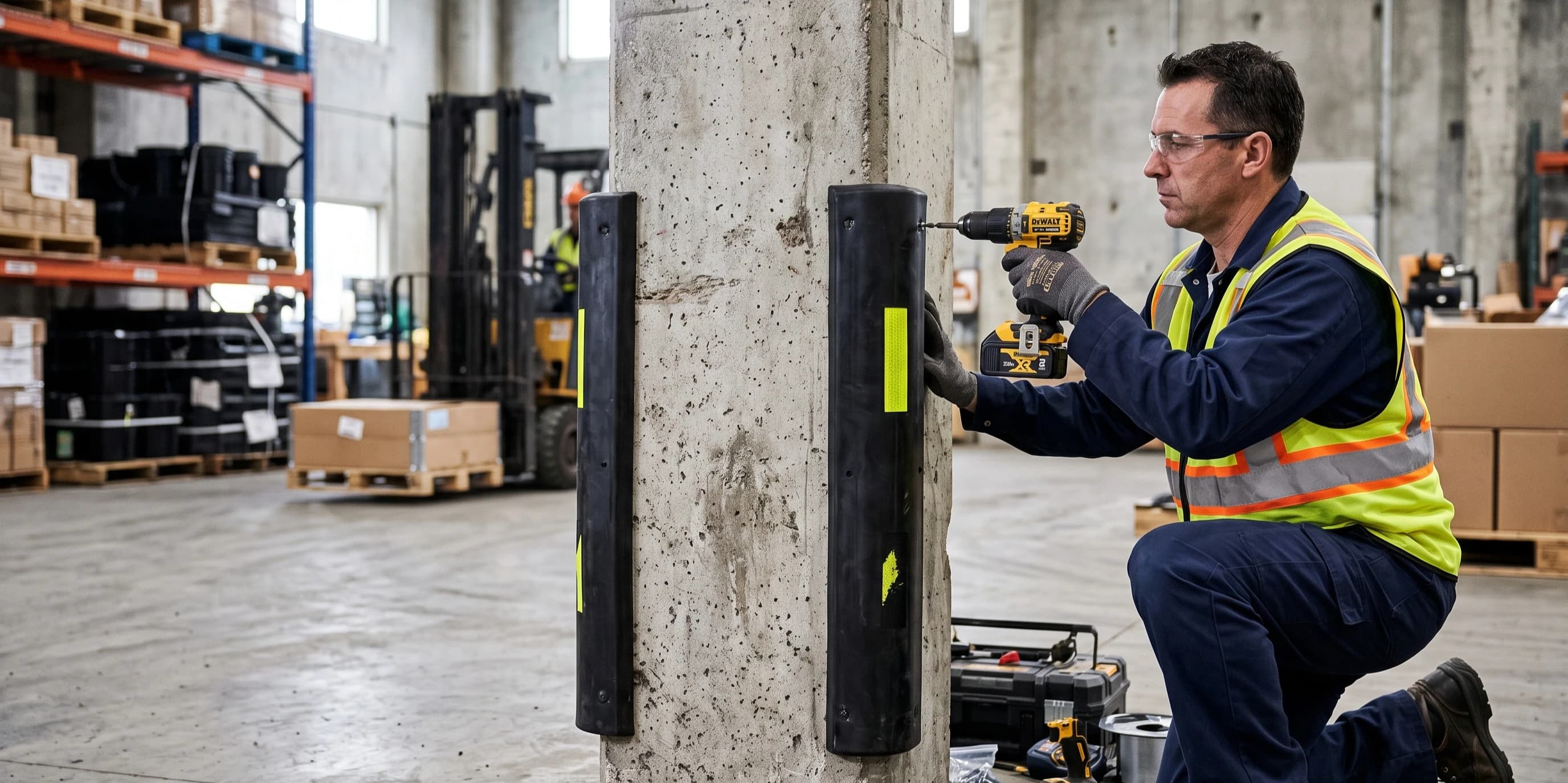
On a factory floor, machinery movement, trolleys carrying components, and general foot and vehicle traffic can all bring equipment close to structural columns and walls. Column corner protection is particularly relevant here, since columns are often positioned directly within working areas rather than tucked away at the perimeter.
High-volume, fast-paced environments like distribution centres see constant movement of goods, often across long shifts. The sheer frequency of trolley and equipment movement makes exposed corners a near-constant point of low-level risk, which is exactly the kind of repeated contact rubber corner guards are designed to handle.
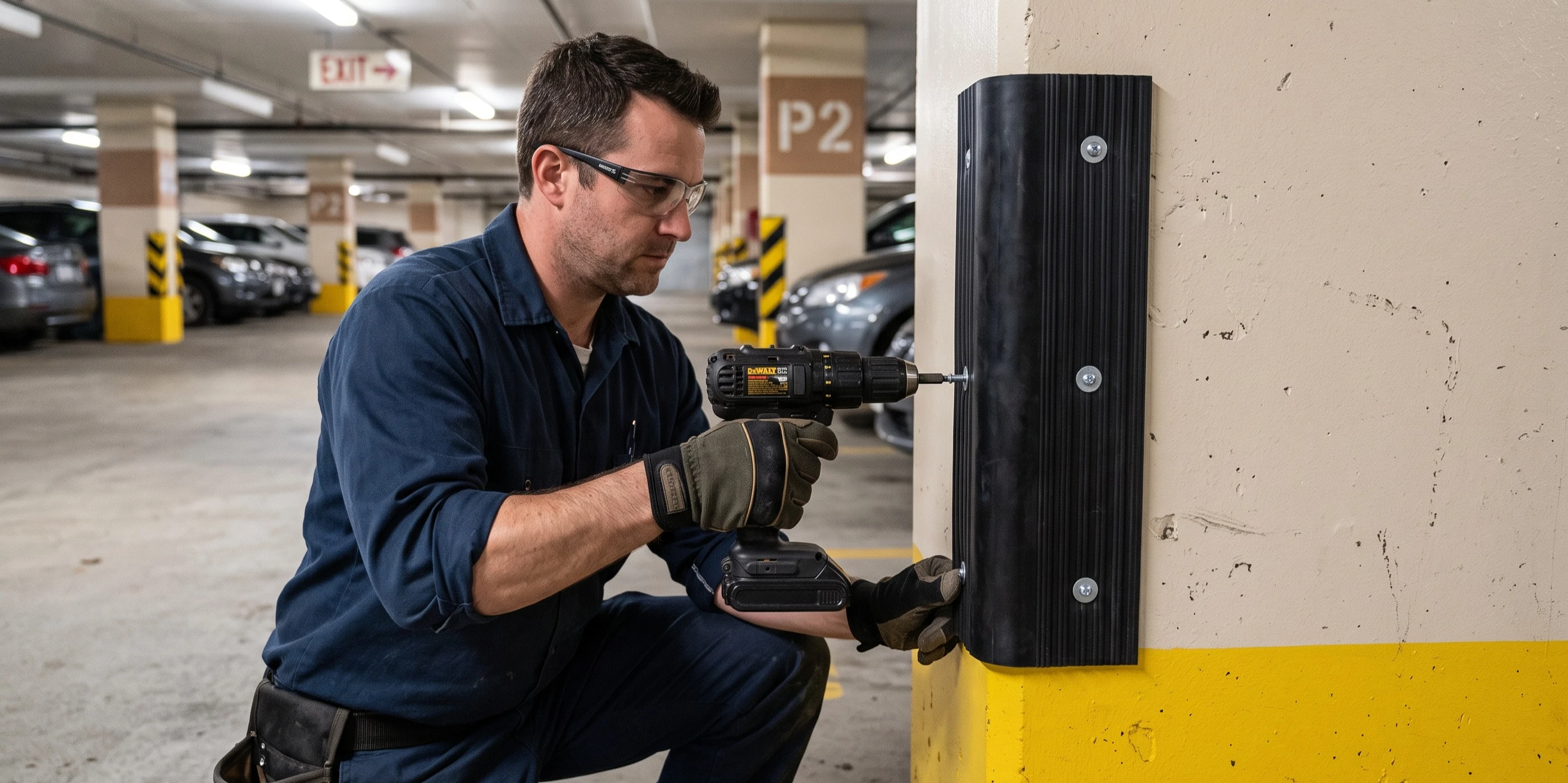
Car park corner protectors are commonly fitted to columns and walls near tight turning areas, ramps and entrances, where vehicles manoeuvre in confined spaces and minor scrapes against structural columns are a familiar problem.
Service yards see a similar mix of vehicle and equipment movement to loading bays, often in a more open but still congested space. At commercial entrances, wall corner protection can help maintain a tidier appearance in areas used by staff, visitors and delivery traffic alike.
Alongside physical protection, visibility is a genuine practical concern around exposed corners. Black rubber corner protectors fitted with yellow reflective or high-visibility markings can make structural edges easier to spot for forklift operators, drivers and staff moving around a site, particularly in busy areas, tight aisles or spots with limited natural light.
This is a useful, sensible addition rather than a substitute for proper safety planning. Corner protectors should not be relied upon to replace formal workplace safety measures, barriers, traffic-management systems or site risk assessments. They work alongside these measures, helping to flag a hazard that might otherwise go unnoticed until contact has already occurred.
Several practical factors are worth thinking through before selecting a product:
https://www.wallcornerprotectors.co.uk/ offers a range of corner protectors suited to different industrial and commercial settings, which can be a useful starting point when comparing options against the factors above.
Exposed wall corners, columns and structural edges are an almost unavoidable feature of busy commercial and industrial premises, and in environments with frequent trolley, equipment or vehicle movement, some level of contact is realistically going to happen. Fitting appropriate corner protection is a straightforward, proactive way to reduce the impact of that contact before it becomes a recurring maintenance problem.
Whether it's a warehouse aisle, a loading bay wall, a factory column or a car park entrance, thinking about corner protection alongside the site's wider safety and traffic-management measures is a practical step that many facilities and site managers find worthwhile.

Walls, columns and corners in warehouses, loading bays and car parking take a battering that most ot
14 September 2026
Stair edge protection is one of those details that's easy to overlook until something goes wrong &md
10 September 2026
Be the first to share your thoughts
No comments yet. Be the first to comment!
Share your thoughts and join the discussion below.
.webp&w=3840&q=75)
.webp&w=3840&q=75)


.webp&w=3840&q=75)

.webp&w=3840&q=75)
.webp&w=3840&q=75)