* All product/brand names, logos, and trademarks are property of their respective owners.
Walls, columns and corners in warehouses, loading bays and car parking take a battering that most other parts of a building never experience. Pallet trucks clip corners, forklifts misjudge turning circles, trolleys catch edges, and vehicles brush against columns while manoeuvring in tight spaces. Over time, this contact leads to cracked plasterwork, chipped masonry, damaged cladding and, in more serious cases, structural repair costs that could have been avoided with the right protective measures.
Choosing the right wall corner protection is not simply a matter of picking the cheapest or most readily available product. Different areas of a building face different levels of risk, and the right solution depends on the type of traffic, the materials involved, the visibility requirements, and whether the area is indoors or exposed to the elements.
This article outlines the main considerations facilities managers, contractors and property owners should weigh up when specifying corner and wall protection for demanding commercial and industrial environments.
Not all impacts are equal. A pedestrian walkway where the occasional trolley brushes a wall presents a very different risk profile to a loading bay where reversing HGVs and forklifts operate throughout the day. Recognising this distinction is the starting point for specifying suitable protection, because a product designed for light knocks will fail — or fail to protect adequately — in a high-impact zone. At the same time, an industrial-grade solution may be unnecessarily bulky or costly in a low-traffic office corridor.
Broadly, three categories of protection cover most commercial and industrial applications: PVC corner guards, aluminium profiles, and heavy-duty rubber corner protectors. Each has a distinct role, and many buildings benefit from using more than one type across different zones.
PVC corner guards are the most common choice for general wear and tear. They are lightweight, tidy in appearance, and relatively straightforward to cut and install, making them well suited to corridors, stairwells, storage areas and other spaces where knocks are frequent but low in force — think trolleys, cleaning equipment or foot traffic brushing past. PVC is not designed to withstand sustained heavy impact, but for everyday wear in lighter-traffic environments it offers a practical, cost-effective and visually neat solution.
Aluminium profiles offer a different set of advantages. They are lightweight yet strong, resistant to corrosion, and can be worked into clean, professional finishes that suit environments where appearance matters alongside durability — reception areas, retail-adjacent warehousing, or building entrances that still see equipment movement. However, aluminium is a rigid material. It does not flex or absorb energy on impact in the way rubber does, so while it resists denting and general damage well, it is not the best choice where genuine impact absorption is required.
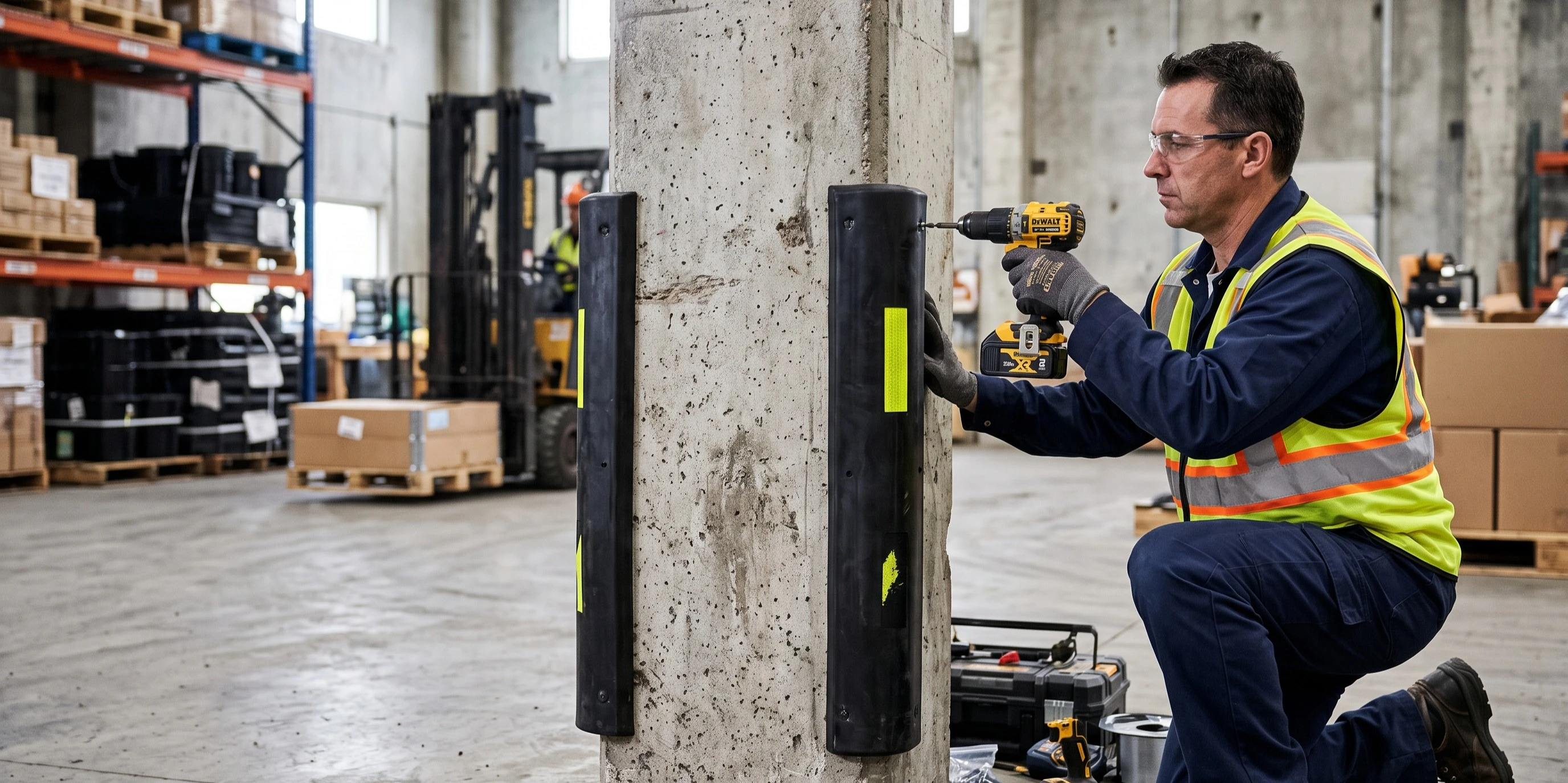
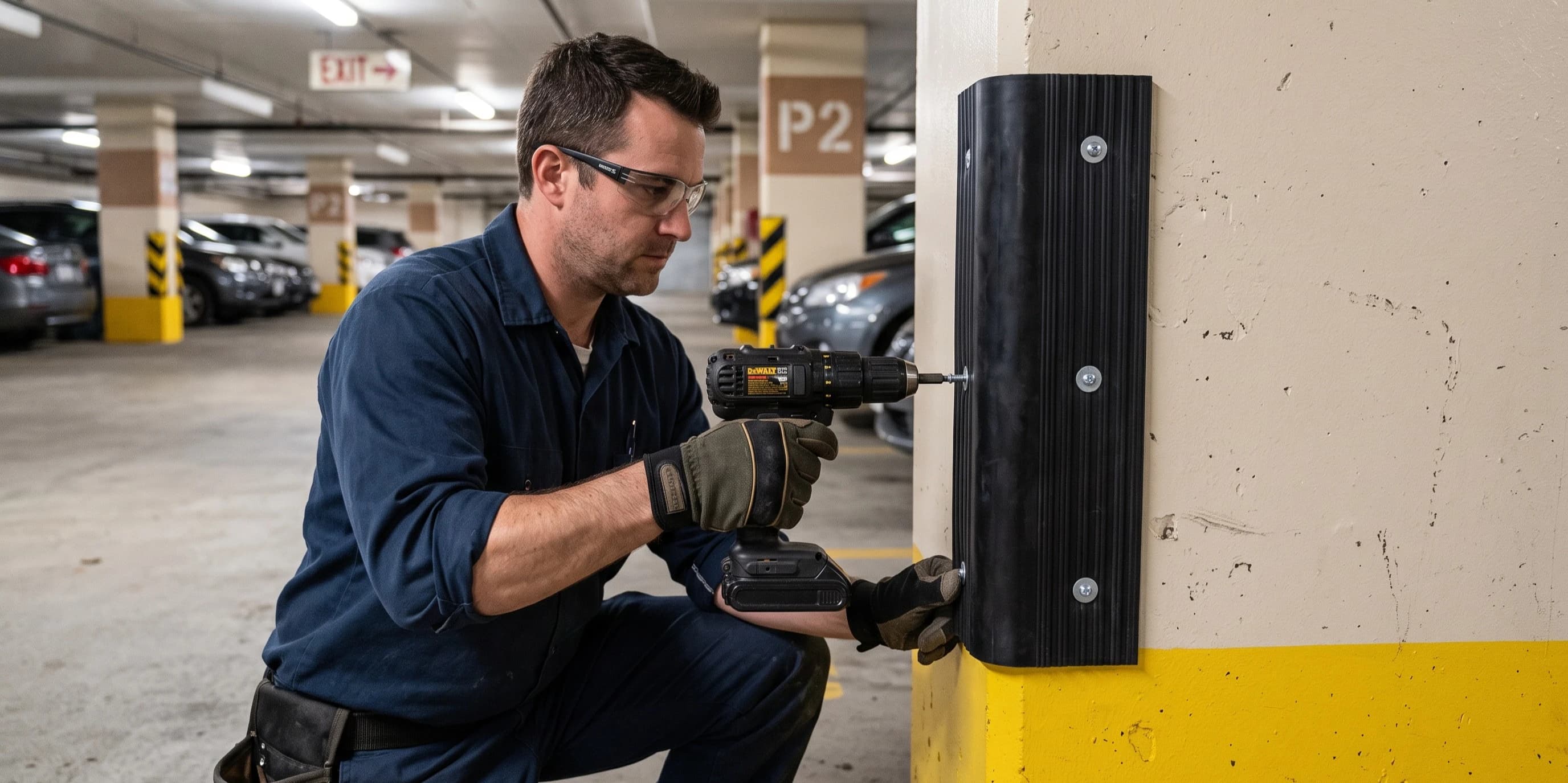
Heavy-duty rubber corner protectors are built for the most demanding areas: loading bays, factory floors, warehouse aisles handling constant forklift and pallet truck movement, and car parks where vehicles regularly pass close to columns and walls. Rubber's key property is its ability to absorb and dissipate impact energy rather than simply resisting it, which has benefits for both the building fabric and the vehicles or equipment involved.
In higher-risk industrial settings, rubber corner protectors offer several practical advantages over rigid alternatives.
The most significant is impact absorption. Rather than transferring the full force of a collision directly into the wall or column, rubber compresses and flexes, spreading the energy of the impact and reducing the shock experienced by the structure behind it. This matters not only for protecting plasterwork, brickwork or cladding, but also for reducing wear on forklifts, pallet trucks and other equipment that might otherwise sustain minor damage from repeated contact with unforgiving surfaces.
This dual protection — safeguarding both the building and the vehicle or equipment — is a key reason rubber is specified so widely in logistics and manufacturing settings. A minor low-speed collision that might chip a PVC guard or dent an aluminium profile can often be absorbed by a rubber protector with no lasting damage to either surface.
Rubber corner guards also tend to be more durable under sustained, repeated contact. Where a corner is struck multiple times a day, over months and years, the cumulative effect on a rigid material can be significant, whereas rubber is engineered to withstand this kind of regular use without degrading quickly.
Beyond physical protection, visibility is an important factor in busy vehicle and equipment areas. Corners and columns positioned near vehicle routes, loading bays or car park entrances can be easy to misjudge, particularly in low light or when operating larger vehicles with restricted sightlines.
For this reason, many industrial rubber guards incorporate yellow or black-and-yellow reflective markings. These high-visibility finishes make corners easier to identify at a glance, helping drivers and equipment operators judge clearances more accurately. In warehouses, garages, car parks and loading areas — where reversing vehicles and manoeuvring forklifts are a daily occurrence — this visual cue can play a meaningful role in reducing minor collisions before they happen, complementing the physical protection the guard itself provides.
| Material | Advantages | Limitations |
|---|---|---|
| PVC | Lightweight, tidy appearance, easy to cut and install, cost-effective, suitable for many everyday applications | Better suited to lighter impacts; less durable under sustained heavy contact |
| Aluminium | Lightweight, corrosion-resistant, workable, professional finish | Rigid; does not absorb impact energy in the way rubber does |
| Rubber | Impact-absorbing, protects both structure and equipment, durable under repeated heavy contact, often available with reflective markings | Bulkier and more industrial in appearance than decorative PVC profiles |
There is no single "best" material — the right choice depends entirely on the demands of the specific location.
Specifying wall and corner protection well means matching the product to the environment rather than applying a one-size-fits-all approach across an entire site. For general wear, PVC remains a sensible and economical option. Where a neat, corrosion-resistant finish is the priority, aluminium performs well. And in loading bays, warehouse aisles and car parks facing regular forklift, pallet truck or vehicle contact, heavy-duty rubber — particularly with reflective markings — offers the impact absorption and visibility needed to protect both the building and the equipment operating within it.
For facilities managers and contractors comparing options across a site with mixed requirements, resources such as Wall Corner Protectors UK can help you review the range of commercial and industrial wall protection products available and understand how different materials perform across varying levels of risk. Taking the time to assess traffic patterns, materials, and visibility needs before specifying protection will help ensure the investment holds up over years of daily use, rather than needing early replacement or repair.

Anyone responsible for running a warehouse, factory or busy commercial site will be familiar with a
15 September 2026
Stair edge protection is one of those details that's easy to overlook until something goes wrong &md
10 September 2026
Be the first to share your thoughts
No comments yet. Be the first to comment!
Share your thoughts and join the discussion below.
.webp&w=3840&q=75)
.webp&w=3840&q=75)
.webp&w=3840&q=75)

.webp&w=3840&q=75)
.webp&w=3840&q=75)