
* All product/brand names, logos, and trademarks are property of their respective owners.
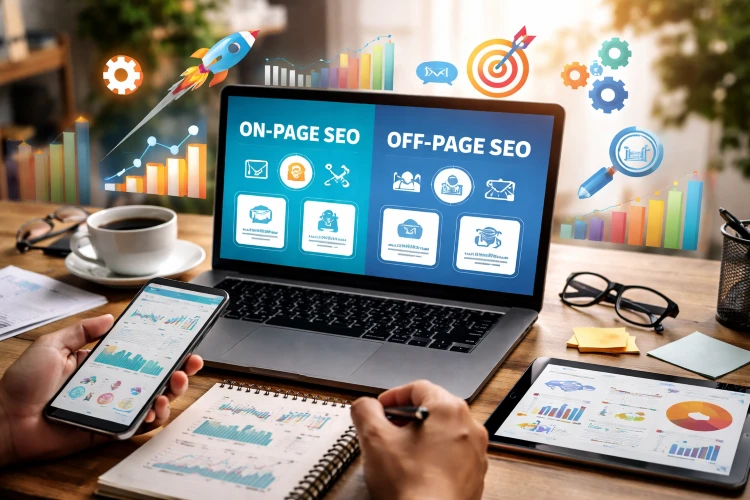
Search engine optimisation has changed a lot over the years, but one debate still confuses many marketers and business owners: on-page vs off-page SEO. Both play a crucial role in how websites rank on Google, yet they are often misunderstood, misused, or treated as separate strategies rather than parts of the same system.
From a digital marketer’s perspective, SEO isn’t about choosing one over the other. It’s about understanding how on-page and off-page SEO work together, when to prioritise each, and how to use them in a way that aligns with business goals. This is especially important for UK businesses, where competition in search results is high, and user expectations are constantly evolving.
The problem is that many guides explain these concepts in isolation. They define terms but fail to answer practical questions like:
Which one should you focus on first?
How do they impact rankings differently?
What actually moves the needle for real businesses?
On-page SEO refers to all the optimisation work done directly on your website to improve its visibility in search engines. Unlike off-page SEO, which relies on external signals, on-page SEO is fully within your control. It lays the foundation for everything else in your SEO strategy — without it, even the best backlinks won’t deliver strong results.
From a digital marketer’s point of view, on-page SEO is where strategy meets execution. It’s not just about adding keywords; it’s about creating pages that serve users first while still being easy for search engines to understand.
Content is the core of on-page SEO. Search engines aim to rank pages that provide the most relevant and useful answers to user queries. This means your content must align with search intent, not just keyword volume.
Effective content optimisation includes:
Using primary and supporting keywords naturally
Structuring content with clear headings (H2s and H3s)
Writing in a clear, easy-to-read format
Answering related questions users are likely to ask
Beyond content, on-page SEO also includes technical elements that affect how search engines crawl and interpret your website. These factors may be less visible to users, but they are just as important.
Key technical on-page elements include:
Title tags and meta descriptions
URL structure
Internal linking
Mobile responsiveness
Page speed and Core Web Vitals
A well-optimised website usually combines strong technical SEO with content that supports broader marketing goals. For instance, aligning on-page SEO with overall digital marketing efforts helps ensure that search traffic converts into meaningful engagement rather than just visits. When discussing how on-page SEO fits into a wider marketing strategy, it’s common for marketers to explore practical guides and real-world examples of digital marketing and content optimisation to refine their approach.
While on-page SEO focuses on optimising your own website, off-page SEO is all about how your site is perceived outside of it. In simple terms, off-page SEO helps search engines determine whether your website is trustworthy, authoritative, and worthy of ranking above competitors.
From a digital marketer’s perspective, off-page SEO is often the most challenging part of SEO because it’s not fully under your control. You can’t force other websites to link to you or mention your brand. Instead, you earn these signals through value, consistency, and credibility.
Off-page SEO goes beyond backlinks. Search engines also look at broader trust signals to understand your brand’s credibility.
These signals include:
Brand mentions (linked or unlinked)
Online reviews and ratings
Social visibility
Digital PR and citations
For UK businesses, local relevance plays a major role. Mentions from UK-based websites, publications, or directories can strengthen geographic trust and improve visibility in local search results.
Understanding how these authority signals work together is a core part of a professional SEO strategy. Many SEO-focused platforms and guides break down these concepts to help marketers build long-term authority rather than chasing quick wins. When analysing backlink quality and authority-building techniques, marketers often explore in-depth SEO Resources that focus on search engine optimisation fundamentals and link strategies.
Although on-page and off-page SEO work toward the same goal — better search visibility — they differ significantly in execution, control, and impact. Understanding these differences helps marketers make smarter decisions instead of spreading efforts too thin.
From a practical standpoint, comparing on-page vs off-page SEO isn’t about choosing one over the other. It’s about knowing what each does best and how they support different stages of growth.
| Factor | On-Page SEO | Off-Page SEO |
|---|---|---|
| Level of Control | Fully within your control. You can update content, optimise pages, improve internal links, and fix technical issues anytime. | Depends on external factors. Backlinks, mentions, and authority signals must be earned over time. |
| Time to See Results | Faster results. Content updates, structural improvements, and technical fixes can impact rankings within weeks. | Slower results. Building authority through quality backlinks and brand mentions takes time. |
| Risk & Sustainability | Low risk when done correctly. Natural optimisation and helpful content rarely lead to penalties. | Higher risk if shortcuts are used. Spammy links or over-optimised anchors can negatively affect rankings. |
| Impact on Long-Term Rankings | Ensures the website is relevant, well-structured, and user-friendly. | Builds trust, authority, and credibility in the eyes of search engines. |
| Primary Role | Helps search engines understand and evaluate the page’s content. | Signals whether the site is trustworthy and respected across the web. |
| Key Question Answered | “Is this page useful?” | “Can this site be trusted?” |
One of the most common questions marketers and business owners ask is whether they should prioritise on-page SEO or off-page SEO. The honest answer is: it depends on your website’s current stage, goals, and resources. However, from a digital marketer’s perspective, there is a clear starting point for most cases.
For new websites, on-page SEO should always come first. Search engines need clear signals to understand what your site is about before they can trust it.
At this stage, the focus should be on:
Creating high-quality, well-structured content
Optimising pages for relevant keywords
Ensuring clean site architecture and internal linking
Improving page speed and mobile usability
Without these fundamentals, off-page SEO efforts won’t perform well. Even if you manage to earn backlinks early on, they won’t have much impact if the website itself isn’t properly optimised.
Different business models require different SEO approaches.
Service-based websites benefit from strong on-page optimisation for conversion-focused pages, supported by off-page authority to build trust.
Content-driven websites rely heavily on on-page SEO for topical depth, while off-page SEO helps amplify reach and credibility.
The most effective strategy blends both approaches based on real performance data rather than assumptions.
From a digital marketer’s perspective, the smartest strategy is to start with on-page SEO and scale with off-page SEO. A well-optimised website makes it easier to earn quality backlinks, while strong authority amplifies the impact of your on-page efforts. Ignoring either side limits growth and makes rankings harder to maintain in competitive markets like the UK.
Rather than chasing quick wins or relying on outdated tactics, focus on creating value, optimising with intent, and building authority naturally. SEO is a long-term game, and websites that respect both on-page and off-page principles are the ones that consistently outperform competitors.

We are a UK-based supplier of stair nosing, wall corner protection, door thresholds, skirting boards, and interior finishing profiles for commercial and residential projects. We provide durable, safety-focused solutions for high-traffic environments, supplying quality products to contractors, architects, and property professionals across the UK.
Whether you’re interested in branding products for your business or just want a unique decal t
12 August 2026
Brands spend huge amounts of money trying to attract new customers online. Ads are everywhere, inbox
9 May 2026
The online dating industry has grown rapidly, and adult dating platforms now face intense competitio
6 April 2026
Be the first to share your thoughts
No comments yet. Be the first to comment!
Share your thoughts and join the discussion below.



%20(1).webp&w=3840&q=75)


.webp&w=3840&q=75)
.webp&w=3840&q=75)


.webp&w=3840&q=75)

.webp&w=3840&q=75)