
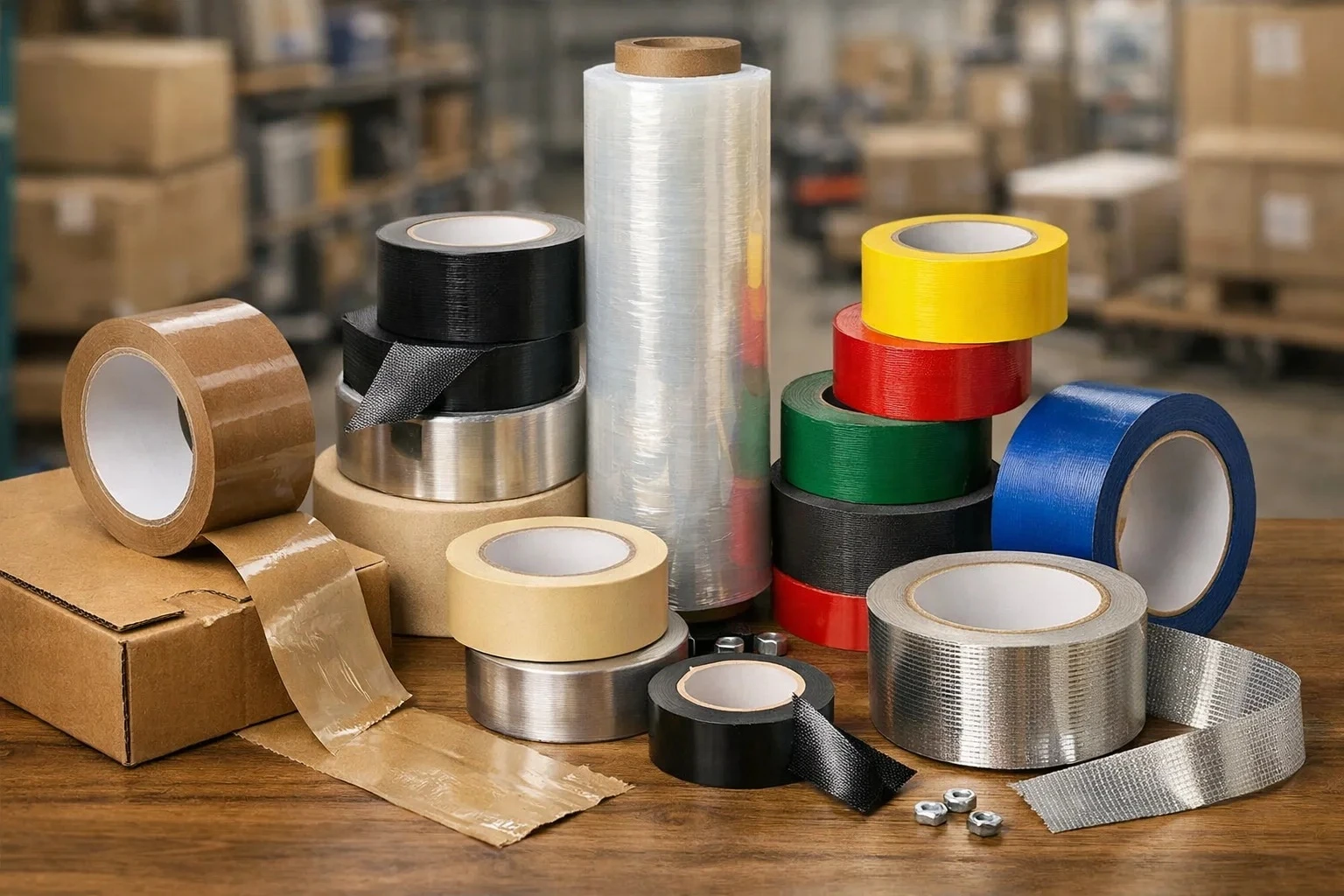
* All product/brand names, logos, and trademarks are property of their respective owners.
Adhesive tapes are one of the most widely used bonding solutions in everyday life and professional environments. From sealing cartons and securing packages to supporting repairs and industrial processes, adhesive tapes provide a fast, clean, and reliable way to bond materials together. Their simplicity, ease of use, and versatility make them an essential tool across homes, offices, warehouses, and factories.
What makes adhesive tapes especially valuable is their ability to perform multiple tasks without the need for tools, heat, or drying time. A single adhesive tape can be used for packaging, temporary repairs, surface protection, or industrial bonding, depending on its strength and adhesive type. Today, high-quality Adhesive Tapes are engineered to handle pressure, movement, and environmental conditions more effectively than ever before.
However, not all adhesive tapes are the same. Selecting the wrong tape can result in weak adhesion, peeling, or product damage. That’s why understanding how adhesive tapes work and where they should be used is essential. In this guide, we focus exclusively on adhesive tapes and explain how they are used for packaging, repairs, and industrial applications, using real and practical examples.
Adhesive tapes are pressure-sensitive products that bond to surfaces when subjected to light pressure. Unlike liquid adhesives or mechanical fasteners, they do not require curing, drying time, or special tools. This makes adhesive tapes ideal for fast-paced environments where efficiency and cleanliness are important.
Every adhesive tape consists of three main components:
This structure allows adhesive tapes to work effectively on a wide range of surfaces, including cardboard, plastic, metal, and glass.
Different adhesive tapes are designed using different adhesive technologies, depending on their intended use.
Common adhesive types include:
1. Rubber-based adhesive tapes
2. Acrylic adhesive tapes
3. High-tack adhesive tapes
Understanding these adhesive types helps users choose adhesive tapes that perform reliably under specific conditions.
Adhesive tapes for packaging are essential for sealing boxes, protecting goods, and preventing tampering during transportation. They are widely used in warehouses, retail stores, and e-commerce operations.
Reliable packaging adhesive tapes reduce product loss, improve handling efficiency, and ensure goods arrive safely at their destination.
Adhesive tapes for repairs provide quick and effective solutions for everyday problems. They are commonly used for temporary and semi-permanent fixes where speed and convenience are important.
Repair adhesive tapes are valued for their flexibility, strong bonding, and ease of application, especially in time-sensitive situations.
In industrial settings, adhesive tapes are used for bonding, securing, insulating, and protecting components across various processes.
Industrial adhesive tapes help improve efficiency by reducing reliance on mechanical fasteners and speeding up installation processes. Many UK businesses rely on consistent adhesive solutions from Commercial Tapes UK, where adhesive tapes are designed to meet professional and industrial performance requirements.
One of the biggest reasons adhesive tapes are widely preferred today is their advantage over traditional fastening methods such as nails, screws, bolts, or liquid adhesives. Adhesive tapes offer a faster, cleaner, and more flexible solution, particularly in environments where speed and surface protection matter.
Unlike mechanical fasteners, adhesive tapes do not damage surfaces. Drilling holes or inserting screws can weaken materials and leave permanent marks. Adhesive tapes create a secure bond without altering the surface, making them ideal for packaging, repairs, and industrial applications where surface integrity is important.
Another key benefit is ease of application. Adhesive tapes require no tools, no curing time, and minimal effort. This allows workers to apply them quickly, reducing labor time and improving productivity. In warehouses and industrial environments, this time-saving advantage can significantly improve workflow.
Adhesive tapes also offer the flexibility that traditional fasteners cannot. They can absorb vibration, movement, and minor surface irregularities without loosening. This makes them especially useful in industrial environments where machinery movement or temperature changes are common.
From a cost perspective, adhesive tapes often reduce overall expenses by minimizing installation time and maintenance needs. Modern adhesive tapes are also engineered to perform reliably under pressure, moisture, and temperature changes, making them a dependable solution for packaging, repairs, and industrial use.
When selecting adhesive tapes, consider the following factors:
Choosing the correct adhesive tape ensures better performance, longer service life, and fewer failures.
Choosing the right adhesive tapes plays a vital role in achieving secure packaging, effective repairs, and efficient industrial operations. The right adhesive tape not only improves performance but also helps reduce downtime, material damage, and rework. Understanding adhesive types and application requirements allows users to make informed decisions instead of relying on guesswork.
If you’re looking for reliable Adhesive Tapes for packaging, repairs, or industrial applications, it’s important to choose a supplier that focuses on quality and performance. Commercial Tapes UK offers adhesive tape solutions designed to perform consistently across a wide range of real-world uses, making it easier to select the right tape for your specific needs.
By choosing application-specific adhesive solutions from Commercial Tapes UK, businesses and individuals can work with greater confidence, knowing their bonding solutions are built for durability, reliability, and professional performance. When it comes to packaging, repairs, and industrial applications, the right adhesive tape truly makes a lasting difference.

I am Burak, a blog writer who enjoys sharing ideas, knowledge, and insights through well-written articles. I like exploring different topics such as lifestyle, trends, technology, and everyday experiences, and turning them into simple, engaging content for readers.
When people plan a renovation, most of the excitement goes toward the big decisions: flooring, paint
17 September 2026
There's a particular kind of room that looks "finished" without you being able to say exactly why. O
7 September 2026
Every trade counter and builders' merchant has a section that's slightly harder to categorise than t
3 September 2026
Be the first to share your thoughts
No comments yet. Be the first to comment!
Share your thoughts and join the discussion below.
%20(1).webp&w=3840&q=75)
.webp&w=3840&q=75)
.webp&w=3840&q=75)

.webp&w=3840&q=75)

.webp&w=3840&q=75)