* All product/brand names, logos, and trademarks are property of their respective owners.
Commercial buildings take a different kind of wear than homes ever do. Trolleys, carts, chairs, and equipment move through corridors all day, every day, and corners are almost always where that traffic leaves its mark. A wall corner protector is a small, low-cost fix for a problem that otherwise turns into repeat plaster repairs and repaint jobs — and once a facilities team starts tracking maintenance costs, corner damage is often one of the most recurring line items on the list.
Unlike a lot of building maintenance issues, this one has a genuinely simple fix. There's no need to redesign a corridor or retrain staff on how they move through a space. A well-chosen corner protector, fitted properly, absorbs the daily wear that would otherwise chip away at paint and plaster, and it does it quietly enough that most people never notice it's there. This guide covers the types available, how to match one to a space, and how to fit it so it actually holds up over time.
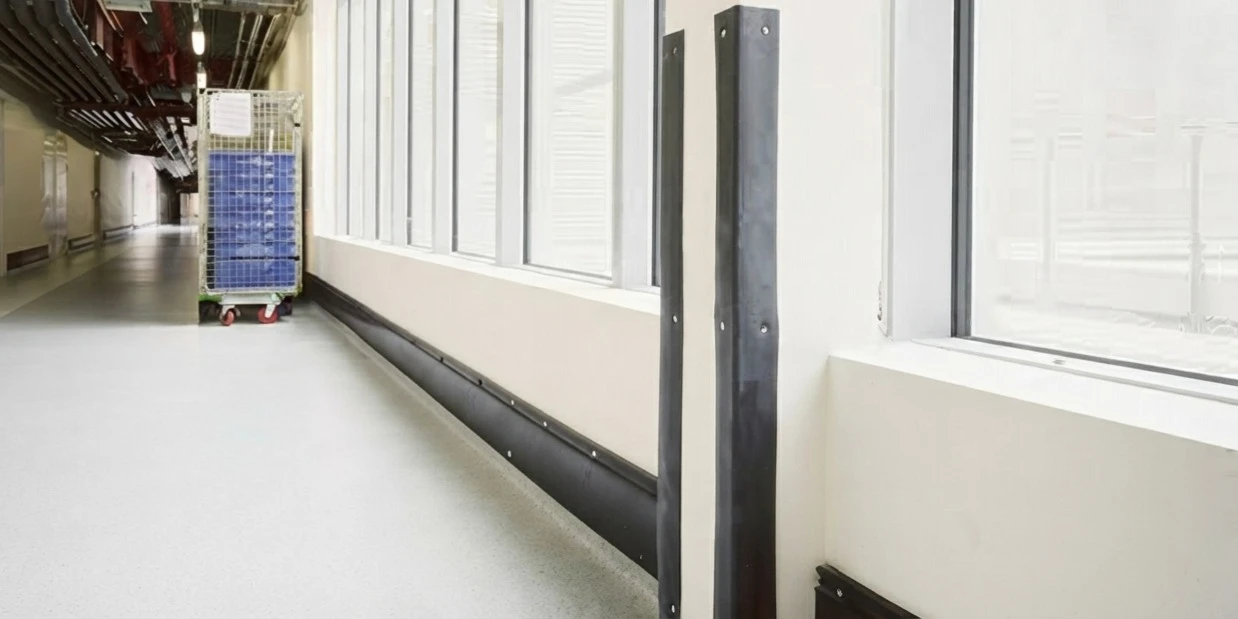
They are built for the highest-traffic areas — loading bays, warehouse aisles, and busy stockroom corridors. They shrug off repeated contact from trolleys and equipment, resist scuffing, and wipe clean easily, though they don't cushion an impact the way softer materials do. Their non-porous surface also makes them easy to keep hygienic in food service or healthcare settings.
They are durable enough for daily knocks, but softer and slimmer than rigid PVC. They're a common choice for office corridors and moderate-traffic walkways where some cushioning is useful but a bulky guard isn't. Many come in a range of colours, which makes it easier to match them to an existing colour scheme rather than having them stand out as an obvious add-on.
It is built for spaces where looks matter as much as protection. Moulded composite or laminate-wrapped MDF gives it the appearance of genuine timber trim, making it a natural fit for reception areas, hotels, and showrooms. It's not designed for the heaviest impact zones, but it handles everyday contact well, and it has the added benefit of reading as a design choice rather than a maintenance patch — useful in spaces where clients or guests will notice the details.
They protect a corner while changing its appearance as little as possible — a good option where the goal is to preserve a specific paint finish or colour scheme rather than make a visual statement. These tend to be the least visible option on a wall and are often chosen for newly decorated spaces where the priority is protecting the existing finish rather than adding a new one.
For a look at the styles and finishes on the market, sites like door thresholds are a useful starting point when narrowing down what fits a specific room.
Corners are the structurally weakest point of any interior wall, simply because they take the full force of an impact on a narrow strip of plaster or drywall instead of spreading it across a flat surface. A flat section of wall can absorb a glancing knock without much consequence, but a 90-degree edge concentrates that same force into a much smaller area, which is exactly why the same corners tend to get damaged again and again rather than the wear being spread evenly across a room.
In commercial buildings, a handful of areas see this problem more than others:
It's rarely a single dramatic collision that causes the damage. More often, it's the accumulation of small, everyday knocks that eventually crack the corner bead underneath the plaster and turn into a repair job. By the time the damage is visible enough to notice, a simple touch-up paint job usually isn't enough to fix it.
| Space type | Best-suited guard |
|---|---|
| Warehouse or loading bay | Rigid PVC |
| Office corridor | Rubber or silicone |
| Reception, hotel, or showroom | Wood effect corner trim |
| Freshly painted or leased space | Clear or low-profile |
Before settling on one option, it's worth checking the wall finish and mounting method too. Textured or freshly painted walls need adhesive-friendly guards that won't cause damage on removal, and leased spaces in particular call for a removable fixing rather than anything permanent, since a landlord may not look favourably on drilled fixings or heavy adhesive residue at the end of a tenancy.
Yes, most adhesive-backed guards are designed to work on both, though it's worth testing on a hidden section first if the paint is fresh or delicate.
Guards with a removable mounting strip are designed for this. Permanent adhesive options are harder to remove cleanly, so they're best avoided in leased spaces.
It holds up well under everyday contact but isn't intended for the heaviest-impact areas like loading bays, where rigid PVC is the better choice.
Corner damage in a commercial building is predictable, and that's exactly what makes it avoidable. Matching the right corner guard to the right space — rigid PVC where traffic is heaviest, wood effect trim where appearance counts, and low-profile options where the goal is to protect without being noticed — turns a five-minute fix into years of savings on plaster and paint repairs.

Be the first to share your thoughts
No comments yet. Be the first to comment!
Share your thoughts and join the discussion below.






.webp&w=3840&q=75)