
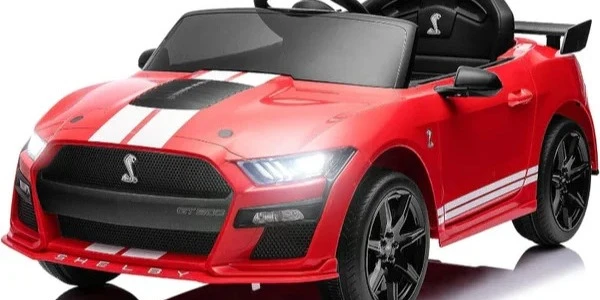
* All product/brand names, logos, and trademarks are property of their respective owners.
Outdoor play gives children a chance to move, explore, and create their own imaginative adventures away from screens and indoor routines. A ride-on vehicle can make that experience even more engaging, allowing children to pretend they are driving a car, going on a road trip, exploring a new destination, or simply enjoying a ride around the garden.
However, not every ride-on vehicle is designed for every outdoor surface.
A small model that works well on smooth flooring may not perform the same way on grass. A larger vehicle that feels comfortable in a spacious garden may be difficult to maneuver in a narrow driveway. Even factors such as tire design, ground clearance, motor configuration, rider weight, and battery capacity can influence how enjoyable the experience becomes.
That's why choosing a vehicle based on where your child will actually ride is just as important as choosing one based on its appearance.
If you're looking for kids' cars for outdoor play, understanding the differences between riding environments can help you choose a model that better matches your child's needs.
This guide explores the main outdoor environments where children may use ride-on vehicles, what parents should consider for each surface, and how to create a safer and more enjoyable riding experience.
Ride-on vehicles may look similar, but their performance can vary significantly depending on the surface underneath them.
A smooth driveway offers relatively little resistance.
Grass creates more resistance.
Loose surfaces can make steering more difficult.
Slopes can affect acceleration and braking.
Uneven ground can place additional demands on wheels, suspension, and motors.
This means that choosing a ride-on vehicle isn't just about asking:
"Which car looks best?"
A better question is:
"Which vehicle is appropriate for the environment where my child will use it?"
Once you answer that question, many of the specifications become easier to understand.
Gardens are among the most popular places for children to use ride-on vehicles.
They provide a relatively controlled environment away from traffic and can give children plenty of room to practise steering and movement.
But gardens aren't always completely flat.
You may have:
Grass
Paving
Soil
Small inclines
Garden borders
Trees
Plants
Outdoor furniture
Before allowing a child to ride, walk around the area and identify anything that could create a hazard.
Grass can be more challenging than smooth flooring.
The tires have to move through the grass while the motors overcome additional rolling resistance.
Several factors become important:
A vehicle with an appropriate motor configuration can perform better on suitable grass surfaces.
Tire design can affect traction and movement.
A heavier rider can increase the load placed on the motors.
More demanding surfaces can consume battery power faster.
Adequate clearance can help with minor surface irregularities.
Parents should still follow the manufacturer's instructions regarding suitable terrain.
A vehicle having large wheels doesn't automatically mean it is designed for rough or off-road use.
Imagine two identical vehicles.
One is driven on smooth concrete.
The other is driven continuously across thick grass.
The second vehicle may need more effort from its motors to maintain movement.
This can result in:
Slower acceleration
Greater battery consumption
Reduced runtime
More strain on the drivetrain
This is normal.
It's one reason parents should consider the riding surface before purchasing a vehicle.
A smooth driveway can be one of the easiest outdoor surfaces for a ride-on vehicle.
The surface is generally predictable and provides less resistance than grass.
However, driveways have one major concern:
Vehicles.
Children should never ride near moving cars.
Even if the driveway is private, parents should ensure that the riding area is separated from vehicle traffic.
If your child will ride on a driveway, establish clear boundaries.
You can use visible markers to define where the child can drive.
The area should ideally be:
Flat
Clear
Away from traffic
Free of sharp objects
Away from stairs
Away from water
Supervised by an adult
The child should understand that the ride-on vehicle stays inside the designated area.
Paved outdoor areas can provide another suitable riding surface.
They are generally smoother than grass and easier for many ride-on vehicles to navigate.
However, check for:
Uneven paving
Cracks
Drainage openings
Steps
Slopes
Loose objects
Even small obstacles can be significant for a child-sized vehicle.
Parents sometimes consider taking ride-on vehicles to parks.
Before doing so, check whether the park permits ride-on toys or battery-powered vehicles.
Even if permitted, consider whether the environment is appropriate.
Public parks may contain:
Pedestrians
Cyclists
Playgrounds
Water features
Uneven surfaces
Crowded paths
A child riding a powered vehicle in a crowded environment can be difficult to supervise.
A controlled private space may often provide a better riding experience.
A ride-on vehicle needs enough room to:
Accelerate
Turn
Stop
Reverse
A larger vehicle may require a wider turning area.
This is especially important for SUV-style and two-seat models.
If your outdoor space is small, a compact vehicle may be easier to operate.
If you have a large garden, driveway, or suitable private area, you may have more flexibility.
Your available space can influence which type of vehicle makes sense.
Consider:
Compact dimensions
Smaller turning radius
Moderate speed
Easy controls
A large two-seater may become difficult to maneuver.
You may have more flexibility.
You can consider:
Larger vehicles
Two-seat designs
Larger wheels
Outdoor-oriented models
But safety remains more important than available space.
Younger children generally need simpler controls and more controlled speeds.
When choosing a vehicle for a younger child, consider:
Age recommendation
Weight capacity
Speed
Steering
Parental remote
Seatbelt
Vehicle size
A parental remote can be particularly useful for adults supervising a beginner.
Parents should remain close enough to intervene directly when necessary.
Older children may be comfortable using more advanced controls.
Depending on their age and the vehicle's specifications, they may enjoy:
Higher-capacity batteries
Multiple motors
Larger body styles
Two-seat vehicles
More realistic controls
Larger wheels
However, bigger doesn't automatically mean better.
The vehicle should still match the child's size and experience.
Tires are one of the most overlooked components when choosing a ride-on vehicle.
Different tires can affect:
Traction
Noise
Comfort
Surface compatibility
Stability
Some models are designed primarily for smooth surfaces, while others are better suited to suitable outdoor areas.
Before purchasing, look at the product specifications rather than assuming that every ride-on vehicle can handle the same terrain.
Basic plastic wheels can work well on smooth surfaces.
More advanced tire designs may provide better interaction with certain outdoor surfaces.
But tire material is only one factor.
A vehicle's:
Motor power
Weight
Suspension
Ground clearance
Wheel size
also influence performance.
Think about the entire vehicle rather than one component.
Ground clearance becomes more relevant when riding outdoors.
A vehicle with low clearance may be more likely to make contact with uneven surfaces.
A higher chassis can provide more room underneath the vehicle.
However, children should never be encouraged to drive over large obstacles simply because a vehicle has greater clearance.
Ride-on vehicles are not intended to replace recreational off-road vehicles.
Some larger ride-on vehicles include suspension systems.
Suspension can help absorb minor changes in the surface and make the ride more comfortable.
It can be particularly useful when driving on suitable outdoor surfaces.
But parents should still avoid:
Large rocks
Deep holes
Steep slopes
Large bumps
Unsafe terrain
Suspension improves comfort; it doesn't make every surface suitable.
Slopes require particular attention.
Even a small incline can affect:
Acceleration
Braking
Steering
Battery usage
Before allowing a child to ride on a slope, check the manufacturer's recommendations.
For younger children, flat surfaces are generally easier to control.
Never allow children to ride near steep drop-offs or slopes leading toward roads, water, or other hazards.
A flat riding area removes several variables.
The child only needs to learn:
Steering
Acceleration
Stopping
Forward movement
Reverse
They don't have to worry about the vehicle rolling downhill or struggling uphill.
Once the child becomes comfortable, parents can evaluate whether other suitable surfaces are appropriate.
Outdoor riding isn't suitable in every weather condition.
Parents should consider:
Rain
Wet surfaces
Extreme heat
Strong winds
Dust
Wet surfaces can reduce traction.
Water can also create problems for electrical components.
Unless the manufacturer specifically states otherwise, ride-on vehicles should not be treated as waterproof vehicles.

Hi, I’m Freya Parker, an automotive expert based in Melbourne. I specialise in helping people navigate the car selling process with confidence and ease. From valuing your vehicle to understanding market trends, I provide practical tips and honest advice to help you get the best possible price. My goal is to make selling your car simple, stress-free, and rewarding no confusion, just clear guidance and results.
MMO games transport players into large virtual worlds that continue to exist even when not online. T
31 August 2026
Online sports and gaming platforms have become increasingly visible among adult internet users in In
11 July 2026
Be the first to share your thoughts
No comments yet. Be the first to comment!
Share your thoughts and join the discussion below.
.webp&w=3840&q=75)





.webp&w=3840&q=75)
.webp&w=3840&q=75)
%20(1).webp&w=3840&q=75)
.webp&w=3840&q=75)