* All product/brand names, logos, and trademarks are property of their respective owners.
Every trade counter and builders' merchant has a section that's slightly harder to categorise than the rest — often labelled "other profiles." It's where you'll find PVC quadrant trim, plastic scotia, U-section melamine edging, worktop profiles, kitchen plinth sealing strip and small-diameter stainless steel tube. None of these products are exciting on their own, but they solve real, practical problems: covering an exposed edge, closing an expansion gap, sealing the base of a kitchen unit, or capping a joint that would otherwise look unfinished.
For homeowners tackling a DIY project, kitchen fitters, furniture makers and general tradespeople, understanding what sits in this category — and which profile suits which job — makes buying decisions far easier. This guide walks through the main products, how they're used, and what to consider before ordering.
These smaller trim and edging components don't fit neatly under flooring, worktops or furniture fittings individually, which is why they're often grouped. They're typically made from PVC, melamine-faced board or stainless steel, and each one is designed to finish, protect or bridge a specific gap or edge.
The most commonly requested items include:
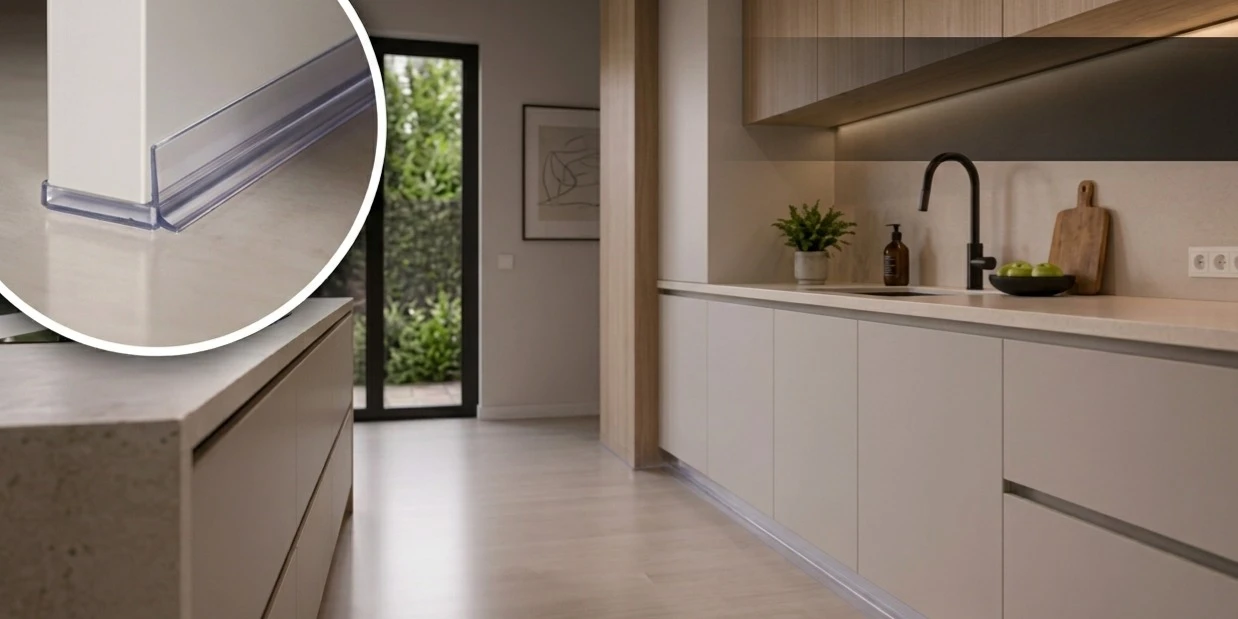
Although they look like minor details on a spec sheet, these products are frequently what separates a tidy, professional finish from one that looks rushed. The kitchen plinth sealing strip is a good example of this: it's easy to overlook during a fit-out, but it does real work once the kitchen is in daily use. Sitting along the bottom edge of the kickboard, it closes off the gap left for levelling the units, stopping spilled liquids, food debris and general dust from working their way underneath.
Quadrant and scotia trims cause the most confusion, largely because they do a similar job but look different.
PVC quadrant trim has a convex, quarter-circle profile and is generally used to cover the expansion gap left between flooring and skirting boards, allowing the floor to move naturally with temperature and humidity without the gap being visible. It's also used around thresholds and panel edges.
Plastic scotia trim has a concave curve rather than a convex one. It performs a similar covering function but is more traditionally associated with carpeted rooms, where its softer profile line suits the flooring type.
For furniture makers, joiners and kitchen fitters, U-section melamine trim addresses a very specific issue: the raw, exposed edge of melamine-faced chipboard or MDF. Left uncovered, these edges are prone to chipping and moisture damage, particularly on cabinet ends, shelving and worktops.
The U-shaped channel fits directly over the board edge, capping it without always needing adhesive or edge-banding tape. This makes it a practical option for flat-pack furniture repairs, bespoke joinery, shopfitting and retail display work, where a quick, clean finish matters.
Two products in this category work together to protect the more vulnerable areas of a fitted kitchen: the worktop edges and the base of the units.
Worktop profiles finish and protect the exposed edges of laminate worktops, particularly at joins, end panels, or where a worktop meets an appliance or wall. Their main function is to shield the chipboard core from moisture, which is one of the more common causes of swelling and delamination in kitchen worktops over time. These profiles are usually colour-matched to the worktop finish and fitted along the vulnerable edge, giving both a protective seal and a neat, professional-looking result.
Kitchen plinth sealing strips do a similar job at floor level. Fitted along the base of the kickboard, they close the gap between the plinth and the floor, keeping moisture, spills and debris from collecting underneath the units. Beyond the practical benefit, they also tidy up the visual line at the bottom of the kitchen, removing the shadow gap that's otherwise left between the plinth and the floor. Most are available in PVC or rubber, with rubber generally offering a bit more flexibility on uneven floors, and PVC being the more common choice for cost and ease of fitting.
A few practical points apply across most products in this category, whatever the specific item.
Profiles are made to fit particular gap widths, board thicknesses or edge depths. Taking accurate measurements — including plinth height for sealing strips, or board thickness for melamine trim — and checking manufacturer sizing charts where they're provided, prevents the common issue of ordering a trim that's almost, but not quite, right.
Most PVC and melamine trims come in a standard range of colours, including white, black, grey and various wood-effect finishes. Taking a sample of the surface being matched (flooring, worktop, plinth or furniture board) along when selecting a trim is a simple way to avoid mismatches caused by lighting or screen colour differences.
PVC profiles generally cope better with moisture than timber alternatives, making them a sensible choice for kitchens, bathrooms and utility spaces — which is exactly why PVC and rubber dominate the plinth sealing strip market. Melamine trims, by contrast, are chosen more for their ability to match furniture boards precisely, giving a consistent, factory-made appearance.
The same principle applies more broadly across finishing trims — from small furniture edging up to larger interior finishing profiles used on staircases and flooring transitions, where selecting the correct material and specification has a direct impact on how well the finish holds up over time.
Quadrant trim has a convex, quarter-round profile and is typically used with laminate, vinyl or wood flooring to cover expansion gaps. Scotia trim has a concave profile and is more commonly used alongside carpeted rooms.
It's still worth fitting one. Tiled floors can be uneven at grout lines, and moisture from mopping or spills can still find its way under the kickboard. A rubber sealing strip often copes better with slightly uneven tiled surfaces than a rigid PVC one.
PVC profiles generally handle moisture better than timber, which is why they're widely used for plinth sealing strips, worktop edging and quadrant trim in kitchens and bathrooms. Timber can still be used in drier areas where a different aesthetic is preferred.
Other profiles may sound like a miscellaneous category, but the products within it do genuinely useful work — protecting edges, covering gaps, sealing the base of kitchen units, and giving a finished, professional appearance to kitchens, furniture and flooring alike. Taking time to measure accurately, choose the right material, and fit each profile with care makes a real difference to how the finished job looks and performs, long after the trim itself has been forgotten about.

Buying a condo can be an exciting step toward homeownership, whether you're purchasing your first pr
2 October 2026
A home elevator can make everyday movement between floors more convenient, especially in multi-store
25 September 2026
When people plan a renovation, most of the excitement goes toward the big decisions: flooring, paint
17 September 2026
Be the first to share your thoughts
No comments yet. Be the first to comment!
Share your thoughts and join the discussion below.


%20(1).webp&w=3840&q=75)






.webp&w=3840&q=75)