* All product/brand names, logos, and trademarks are property of their respective owners.
Robotics is changing how students understand technology. It combines programming, engineering, electronics, mathematics, and problem-solving in a practical learning environment. A Robotics Olympiad gives students an opportunity to explore these skills through challenges that encourage them to think, experiment, and create.
The World Tech Olympiad provides students with a global technology competition where robotics connects with future-focused areas such as Artificial Intelligence, coding, cybersecurity, and computational thinking.
A Robotics Olympiad is a technology competition where students apply robotics, programming, logic, and engineering skills to solve challenges.
Instead of learning concepts only from books, students can see how instructions affect machines and how different components work together. Depending on their age and experience, activities may involve:
The focus is not only on building a robot. Students also learn to plan, test, identify problems, and improve their solutions.
The World Tech Olympiad brings robotics into a broader technology-learning environment. Students can explore robotics alongside AI, coding, cybersecurity, computational thinking, mathematics, and logical reasoning.
WTO is designed for students from Class 2 to Class 12 through different learning tracks.
Younger students can develop basic technology awareness through visual coding, sequencing, logic, introductory AI concepts, and age-appropriate robotics ideas.
Students can move toward programming, computational thinking, Python fundamentals, robotics concepts, AI and data, and cybersecurity awareness.
Older students can explore applied AI, machine learning, robotics, algorithms, cybersecurity challenges, and technology projects.
Robotics turns abstract technology concepts into something students can see and interact with. When a student programs a robot to move, respond to an obstacle, or perform a task, they can immediately observe the result.
This process can help develop:
Robotics also teaches students that mistakes are part of learning. When a robot does not behave as expected, students can test their ideas, identify problems, and make improvements.
A competition can make robotics learning more engaging because students have a specific challenge to solve. They need to understand the problem, develop an approach, use available tools, and evaluate their results.
This creates a practical learning cycle:
Understand → Design → Program → Test → Improve
Following this process helps students develop a structured approach to problem-solving.
Students learn how programming controls movement, decisions, and automated actions.
They learn to break complicated tasks into smaller steps and organize them logically.
Robotics encourages students to understand how different components work together to create a functioning system.
When a robot does not behave as expected, students need to identify the cause and find a solution.
Robotics challenges can have multiple solutions, allowing students to experiment with different ideas and designs.
Testing and debugging teach students that failed attempts can provide useful information for the next solution.
Robotics and Artificial Intelligence often work together. AI can help robots process information, recognize objects, analyze data, and make decisions, while robotics provides the physical environment where these systems perform actions.
Students interested in robotics can later explore:
Learning coding and computational thinking can provide a useful foundation for these advanced concepts.
Students do not need to be robotics experts before they begin. Beginners can start with basic concepts such as:
As their knowledge grows, they can gradually explore more complex robotics and programming concepts.
Parents can support children by:
Children do not need expensive equipment to begin developing an interest in robotics. Simple programming activities, educational resources, and logical challenges can provide a starting point.
Schools can use robotics competitions to make STEM learning more practical and engaging. Robotics connects different subjects, including mathematics, science, and coding.
Schools can use robotics learning to encourage:
A robotics competition can also help students discover interests that may lead toward engineering, computer science, AI, or other technology fields.
Good preparation should combine technical knowledge with problem-solving practice.
Students should understand programming concepts appropriate to their age and learning level.
Basic knowledge of sensors, movement, automation, and robotic components can be useful.
Logic puzzles and computational challenges can improve the thinking skills needed for robotics.
Small projects allow students to see how programming and hardware interact.
Trying different approaches can help students discover more efficient solutions.
Debugging is an important robotics skill. Students should understand why something failed before changing their approach.
Robotics can introduce students to several future career paths, including:
For learners who later become interested in blockchain and Web3, Blockchain Council offers specialized courses and certifications.
Students who want to continue developing technology expertise can explore learning opportunities through Global Tech Council.
For those who want to combine technology knowledge with business, marketing, or professional skills, Universal Business Council provides business and professional certification programs.
Regular robotics learning usually focuses on teaching concepts, building systems, and completing projects. A Robotics Olympiad adds a competitive element where students apply their knowledge to specific challenges.
Both approaches are valuable. Learning provides the foundation, while competition gives students an opportunity to test and demonstrate what they have learned.
Robotics can also support personal development.
Completing challenging projects can improve students' confidence in solving problems.
Many robotics activities encourage students to discuss ideas and work together.
Students may need to explain how their robot works or why they selected a particular solution.
Robotics projects rarely work perfectly on the first attempt, so students learn to adjust their approach.
Students evaluate different options and select an approach that can solve the given challenge.
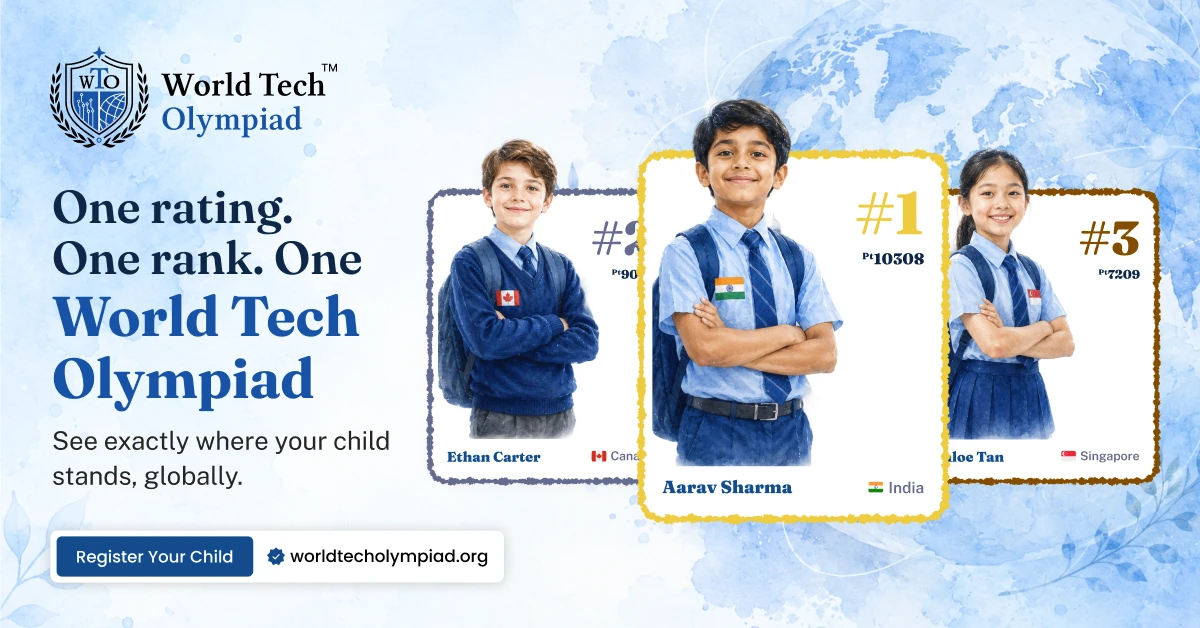
Competition can give students a measurable way to track their progress. The World Tech Olympiad provides skill ratings and global rankings, allowing participants to understand their performance and follow their development.
Eligible achievements can also receive verifiable certificates with unique IDs, which can motivate students to continue learning and explore advanced technology areas.
The World Tech Olympiad (WTO) allows students to explore robotics as part of a wider technology ecosystem. Students can develop knowledge across:
This broader exposure can help students discover the technology areas they enjoy most. The online competition format also allows students to participate remotely without travelling to a physical examination center.
A Robotics Olympiad can introduce students to technology in a practical and engaging way. It allows them to move beyond simply using technology and start thinking about how machines can be programmed, controlled, and improved.
The World Tech Olympiad (WTO) combines robotics with coding, AI, cybersecurity, and computational thinking to create a broader technology-learning experience for school students.
For parents, robotics can encourage curiosity and creativity. For schools, it can strengthen STEM initiatives and give students opportunities to apply classroom knowledge.
The most valuable outcome may not be a competition rank. It can be the ability to approach a difficult problem, test an idea, learn from failure, and keep improving.
A Robotics Olympiad is a technology competition where students use robotics, programming, logic, and problem-solving skills to tackle challenges.
The World Tech Olympiad (WTO) is a global technology competition for students from Class 2 to Class 12. It covers robotics along with AI, coding, cybersecurity, and computational thinking.
Not necessarily. Students can explore robotics according to their class and learning level. Beginners can start with basic programming, logic, and robotics concepts.
WTO is designed for students from Class 2 to Class 12 through Foundation, Explorer, and Innovator tracks.
Robotics can help students develop programming, logical reasoning, problem-solving, creativity, computational thinking, engineering awareness, and persistence.

No bio available yet.
There is something special about the moment a child becomes completely absorbed in a story.
1 October 2026
Be the first to share your thoughts
No comments yet. Be the first to comment!
Share your thoughts and join the discussion below.







.webp&w=3840&q=75)